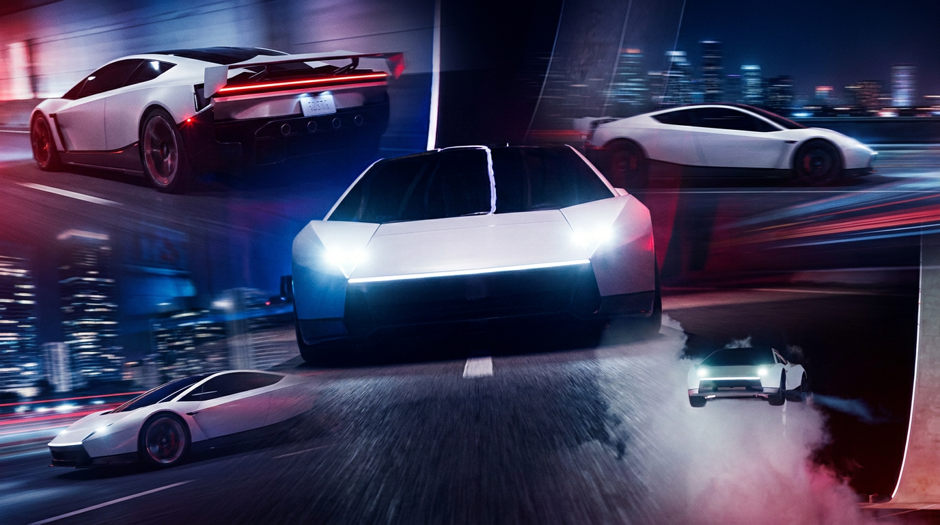
Tesla presented three versions: Performance, Thrust, and Rocket. Performance is the road-ready two-seater with active aero and a multi-mode suction system. Thrust adds rear cold-gas thrusters for sub-one-second 0-60 mph acceleration, and Rocket is a single-seat, invite-only machine with thrusters around the body that can fly. Tesla claims 0-100 km/h in 2.1 seconds, a 400 km/h top speed, and 1,000 km of range from a 200 kWh battery and tri-motor all-wheel drive. The Rocket and Thrust variants are assumed to be not road-legal, and Tesla has not said whether their defining features will survive regulatory review.
The Delay
The Roadster 2 was first shown in November 2017 with a promised 2020 production date with an entirely different design. Since then Tesla has pushed production to 2021, 2022, 2023, 2024, 2027, and now 2028, while the unveiling itself slipped from late 2025 to April 2026, then August, then October 15, 2026. Reservation holders have paid $50,000 deposits and waited nine years for a car that does not exist in customer form. Musk has called the timeline a hope rather than a guarantee, and the company has instead delivered a budget and SUV lineup.
The Manufacturing
The stunt prototype is not a production car, and Tesla has not confirmed a factory, supply chain, or production line for the Roadster 2. Musk has said production will be capped at 10,000 units per year, roughly 27 cars per day, which is a niche volume compared with Tesla’s mass-market models. The car requires cold-gas thrusters, suction fans, active aero, steer-by-wire, and exotic magnesium, titanium, and carbon fiber components that Tesla has never mass-produced. Tesla has not explained how it will certify a flying vehicle with the FAA or NHTSA or how it will build thrusters at scale.
The Unanswered Questions
Tesla did not announce a price, a production location, or a delivery date beyond 2028. The Rocket version cannot legally fly under current FAA rules and cannot legally drive under NHTSA rules, leaving it in a regulatory gap that Tesla has not yet filled. Tesla has not confirmed whether the base Performance model will be road-legal, and the Thrust and Rocket features that define the unveiling remain race-only or air-only. Customers still do not know what they will receive, when they will receive it, or how much it will cost, but those who paid a huge sum of deposit nine years ago are sure in their anger.
The Verdict
The new Roadster is a technological spectacle made for showcasing its engineering marvel and interoperability across Musk's company, not necessarily a mass market product. It flies, drives upside down, and accelerates faster than a Formula 1 car, but it has no price, no factory, no regulatory approval, and a timeline that has slipped for nine years. It could be the one thing that separates it from the ever-growing competition with Chinese EV makers that offer better features that are now common in electric cars. Until then, the Roadster 2 remains a promise, and Tesla’s latest deadline is only the renewed version of that promise.
This marketing material is provided for informational purposes only and does not constitute investment advice, a recommendation, or an offer or solicitation to buy or sell any financial instruments.
Trading in securities involves significant risk and may not be suitable for all investors. Prices of securities may fluctuate significantly and may result in a total loss of your investment. Investors should be aware that losses may exceed potential profits when buying and selling securities. In certain market conditions, you may sustain losses that exceed your initial investment. Securities and contracts for differences are complex financial instruments that require a high level of knowledge and understanding. You should carefully consider whether you understand how these instruments work and whether you can afford to take the high risk of losing your money.