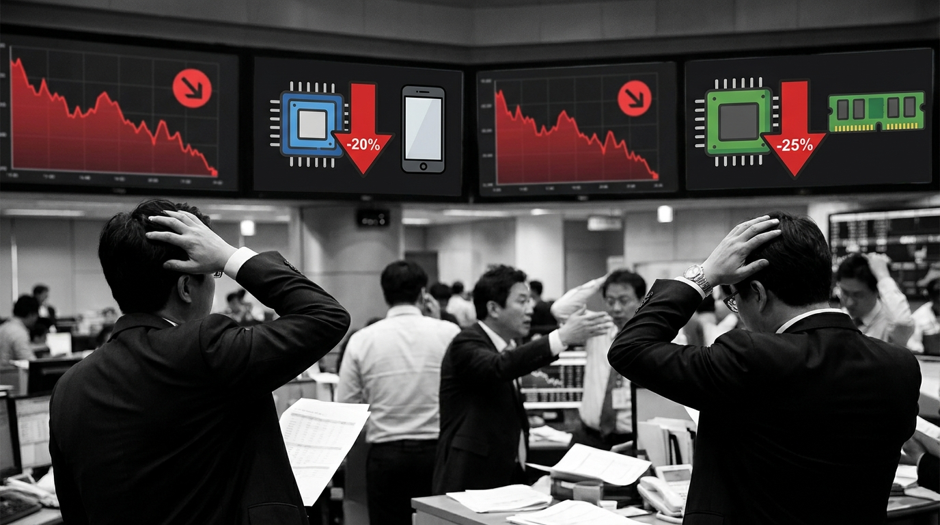
AI customers must now fund their own spending
Reuters reported that the 2026 capital spending forecasts for five major US hyperscalers rose from about $485 billion in January to roughly $730 billion in July, and that their capex could exceed free cash flow by 2027. FactSet found that incremental debt covered 32% of hyperscaler capex in the year through June 2026, up from 9% in fiscal 2024, which lifted aggregate debt to roughly $700 billion. Investors now ask how much of the buildout operating cash supports and how much depends on debt, equity, leases, and customer financing. Memory demand comes from this spending, so forecasts can be cut before any manufacturer reports weaker shipment.
Higher rates cut the value of distant profits
Moneycontrol tied the October selloff to hotter US inflation data and rising expectations of Federal Reserve tightening. A company whose largest expected profits lie years ahead loses more present value when the discount rate rises, and customers building data centers pay more to borrow. State Street describes the credit market as mature-cycle, with high rates, tight spreads, and little policy flexibility; The multiple falls first, and earnings suffer later only if customers defer orders.
Record profit can mark the top of a memory cycle
High memory prices attract capital spending, and the fabs built with it add supply after demand growth has already cooled. Investors price that sequence early, so a record year can lower the multiple on the earnings behind it. SK Hynix's second-quarter profit set a record and still missed forecasts, and the shares fell 10%. HBM prices expanded less than conventional memory prices, and long-term contracts can cap the upside from spot-price spikes.
HBM4 delivery and market share now decide the premium
Analysts attributed part of the second-quarter miss to slower HBM4 shipments, which delayed revenue recognition. Counterpoint put SK hynix’s HBM share at 50% in the second quarter of 2026, down from 64% a year earlier. Sales can rise while share falls in a fast-growing market, but a smaller share weakens expectations for pricing power as Samsung and Micron ramp competing products.
Crowded positioning turned a repricing into a rout
SK hynix shares gained more than 1,000% in the 12 months to the June peak, and leveraged exchange-traded products amplified the swings. After the July Nasdaq debut, the Seoul shares fell 15.4% in one session as the premium between the two listings narrowed. In October, foreign investors sold more than $10 billion of Kospi shares, and a US semiconductor-stock gauge lost $1.6 trillion over a six-session losing streak. These flows explain the speed of the decline but say nothing about fair value, which depends on whether AI customers can finance and monetize enough infrastructure to keep memory demand profitable.
This marketing material is provided for informational purposes only and does not constitute investment advice, a recommendation, or an offer or solicitation to buy or sell any financial instruments.
Trading in securities involves significant risk and may not be suitable for all investors. Prices of securities may fluctuate significantly and may result in a total loss of your investment. Investors should be aware that losses may exceed potential profits when buying and selling securities. In certain market conditions, you may sustain losses that exceed your initial investment. Securities and contracts for differences are complex financial instruments that require a high level of knowledge and understanding. You should carefully consider whether you understand how these instruments work and whether you can afford to take the high risk of losing your money.
Source: https://www.reuters.com/legal/transactional/is-ai-rout-making-bonds-safe-again-2026-10-15/