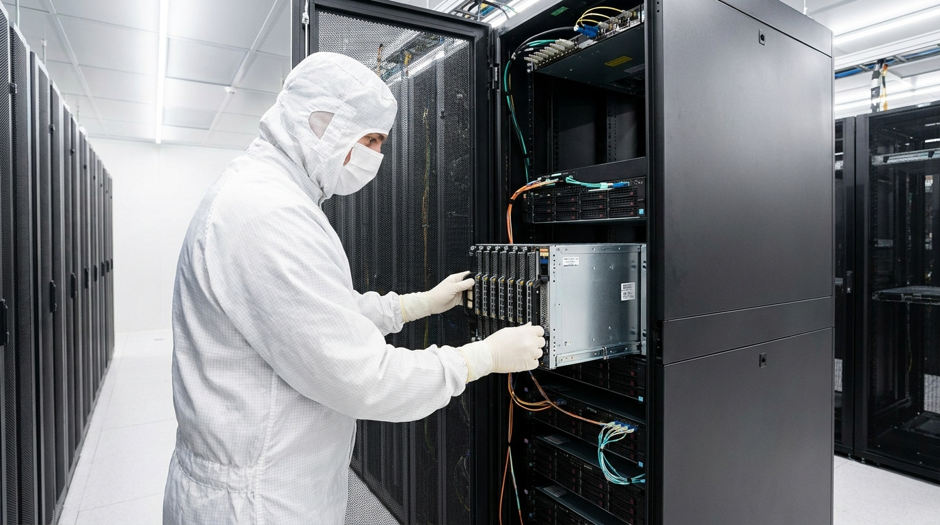
Broadcom reported $29.6 billion in revenue for the quarter ended August 2, up 86% from a year earlier, with AI semiconductor revenue of $16.7 billion, up 221%. Nvidia reported $96.2 billion for its July quarter, up 106%, including $89.0 billion from Data Center, and guided to $108 billion for the next quarter. These figures measure what chip suppliers sold. A chip becomes a return only after it is installed, powered, filled with paying workloads, and sold as cloud capacity, and a supplier can post record results while its buyers earn weak returns on the same hardware.
The spending burden sits with the buyers
Microsoft (about $175 billion), Amazon (about $220 billion), Alphabet ($180–190 billion), and Meta ($130–145 billion) have guided to roughly $705 billion to $730 billion of combined 2026 capex. Nvidia spent only $2.7 billion on property, equipment, and intangibles last quarter because it designs chips and leaves construction to its customers. Microsoft said about two-thirds of its $31.9 billion quarterly capex went to short-lived equipment, mainly GPUs and CPUs. Accelerators lose economic value faster than buildings and power connections, so a fleet can become obsolete before the debt or lease that paid for it is retired.
Cloud profits are rising while free cash flow shrinks
Amazon's AWS revenue grew 37% to $42.2 billion with $16.6 billion of operating income, yet Amazon's trailing twelve-month free cash flow turned to an outflow of $7.6 billion as property and equipment purchases rose by $66.1 billion. Azure grew 43%, and Microsoft reported a $678 billion contracted cloud backlog, though a backlog is a promise of future revenue, not cash in hand. Meta shows the sharper version: revenue grew 28% to $60.8 billion while costs rose 55% and free cash flow fell to $784 million. Strong demand and profitable cloud units therefore coexist with investment that absorbs the cash the core businesses generate.
Usage is spreading faster than financial payoff
McKinsey's August survey found that 44% of respondents were scaling AI across their enterprise, but only 37% reported a positive contribution to EBIT, and only 6% qualified as high performers. Bloomberg reported Anthropic's annualized revenue above $65 billion and OpenAI's near $50 billion, heading toward $70 billion by year-end. The two companies calculate their run rates differently, and neither figure shows margins, cash burn, or how much compute arrives through credits and prepayments. Because one end-user dollar passes from application to cloud to chipmaker, fast growth at every layer cannot prove that the whole stack earns a profit.
Debt turns a strong industry into a fragile one
PIMCO estimated that capex could consume 94% of the five largest hyperscalers' operating cash flow in 2026 and 2027, against 40% in 2023, and counted $822 billion of lease commitments not yet on their balance sheets. About $136 billion of hyperscaler investment-grade debt had been issued by May, with a further $58 billion tied to data centers. The giants have enough cash flows to absorb this strain, but newer data center operators that depend on long-term tenants, power delivery, and refinancing are more fragile and exposed to funding risk. Tan's remark about capital as the constraint marks that boundary where AI usage can keep climbing while higher funding costs erase the economics of the marginal data center, and the test for the industry is whether that marginal project earns its cost of capital.
This marketing material is provided for informational purposes only and does not constitute investment advice, a recommendation, or an offer or solicitation to buy or sell any financial instruments.
Trading in securities involves significant risk and may not be suitable for all investors. Prices of securities may fluctuate significantly and may result in a total loss of your investment. Investors should be aware that losses may exceed potential profits when buying and selling securities. In certain market conditions, you may sustain losses that exceed your initial investment. Securities and contracts for differences are complex financial instruments that require a high level of knowledge and understanding. You should carefully consider whether you understand how these instruments work and whether you can afford to take the high risk of losing your money.