
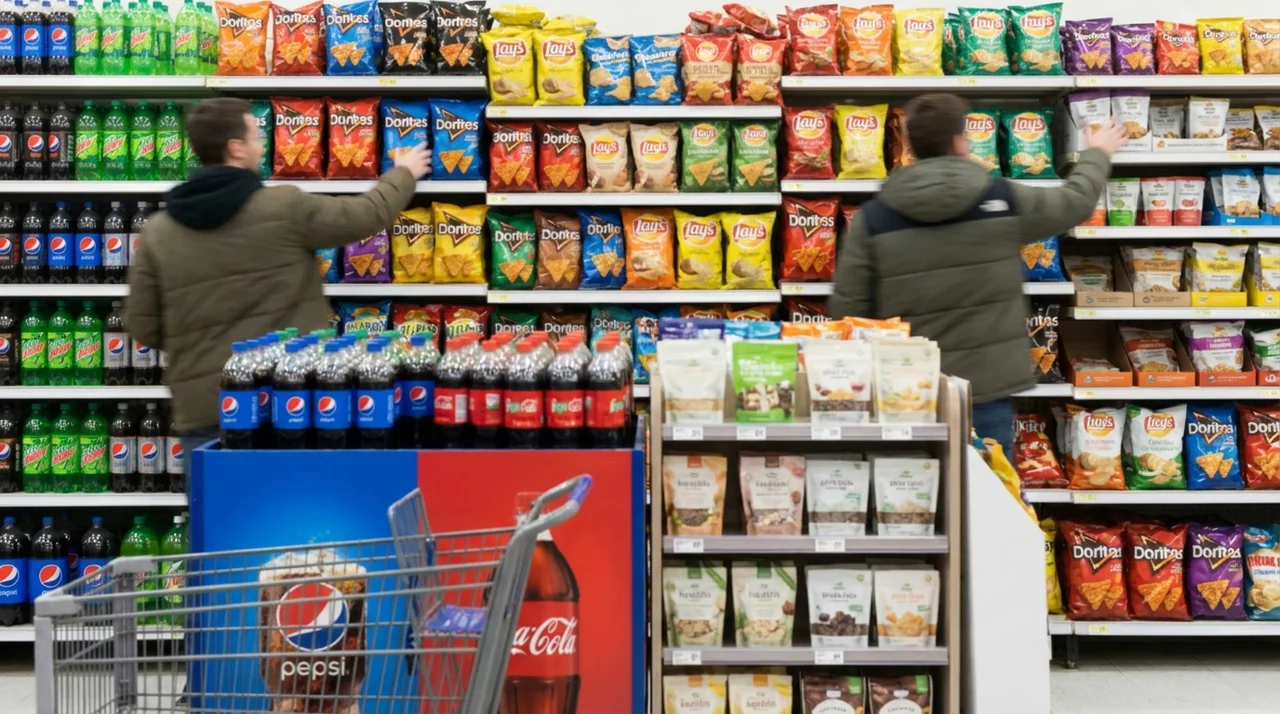
PepsiCo's finances look solid, where revenue grew in both Q1 and Q2, the company held its full-year growth targets, and it raised its dividend for the 54th year in a row. The weak spot is Frito-Lay North America, where Q2 revenue fell 2% and snack volumes keep sliding, following 2025's first annual revenue drop since 2008. International growth helps, but it doesn't offset the pressure on the North American snack business that funds so much of PepsiCo's cash returns. What began as an inflation problem now looks structural, tied to GLP-1 drugs and shifting eating habits, so the next earnings report is a real test of whether Pepsi can make up the lost volume with higher-value products before the core franchise erodes further.
Pepsi’s GLP-1 Playbook
CEO Ramon Laguarta told investors in February that GLP-1 drugs are "more opportunity than threat," and PepsiCo's response runs through four lanes. The first is portion control, since more than 70% of its U.S. food business already sells in single-serve packs, which suits people eating less. The second is protein, with Doritos Protein, Propel Clear Protein, and Muscle Milk. The third is fiber and gut health, through a repositioned Quaker, SunChips Fiber, and the $1.95 billion Poppi acquisition. The fourth is hydration, which Laguarta sees as the strongest GLP-1 trend, with Propel growing over 20% and Gatorade pushing more low-sugar options. The question is whether the playbook is deep enough that a 10-gram protein Dorito is an entry point rather than a protein powerhouse, and Poppi is a good asset in a crowded functional soda market. PepsiCo has built several lanes into the GLP-1 economy, but none is big enough yet to offset a lasting slide in traditional salty snacks.
Competitors Are Moving Faster on Protein
Coca-Cola has the clearest edge in protein drinks, with Fairlife and Core Power growing fast and a large U.S. dairy plant under construction to expand supply. CEO James Quincey says GLP-1 users clearly drink more protein beverages, and zero-sugar diet drinks already make up a double-digit share of Coke's soft drink volume. General Mills calls GLP-1 a lasting change and has added Honey Nut Cheerios Protein and Ghost bars, while Mondelez gets instant exposure through Clif and Builders. Kraft Heinz launched PowerMac with 17 grams of protein aimed at GLP-1-adjacent shoppers, and Nestlé is using AI to develop products like a 35-gram protein Boost shake and Vital Pursuit frozen meals, marketed through social media rather than GLP-1 labels. PepsiCo's innovation breadth rivals any of them, but its protein density doesn't, since Fairlife and Boost beat Doritos Protein on grams per serving, and General Mills and Mondelez already own established protein snack brands. PepsiCo has to prove its snack scale can become protein leadership, not just protein participation.
Demand Is Shrinking and Reallocating
About 1 in 9 Americans now take GLP-1 drugs, and users eat roughly a fifth fewer calories, spend nearly a third less on groceries, and cut desserts by as much as 84%, which could cost the food and beverage industry $30 billion to $55 billion a year by 2030. Another projection predicts that by 2030, about 23% of U.S. households will include a GLP-1 user, and those households will account for 35% of food and beverage volume, buying fewer units but paying more for protein, fiber, hydration, and digestive support. That's where the growth is, with the protein snack market on track to roughly double by 2034 and functional snack reformulation growing nearly 14% a year. Poppi, Siete, Propel, and PepsiCo's protein extensions are participating in this shift, but timing is the risk, because if legacy salty snacks shrink faster than the functional lines scale, revenue falls even while the new products grow.
The Earnings Verdict Hinges on Two Numbers
The harder problem for PepsiCo may not be the products but the identity behind them. Frito-Lay built its empire on indulgence, on chips people grab without thinking, and GLP-1 users are now thinking about every bite or not thinking of food at all. A protein Dorito asks shoppers to justify a treat, while Fairlife and Boost never have to, because the nutrition is the whole pitch. That is why the premium may go to whoever owns a nutritional claim rather than whoever has the most shelf space, and it is why grams of protein are only part of the story. PepsiCo's real edge is on its distribution capacity, which can put a new product in front of millions of shoppers almost overnight. But reach only helps if people want what's being delivered. If shoppers start seeing Pepsi as a snack company that added protein rather than a protein company that happens to make snacks, the scale that once protected it could end up propping up a business the market no longer wants to pay up for.
This marketing material is provided for informational purposes only and does not constitute investment advice, a recommendation, or an offer or solicitation to buy or sell any financial instruments.
Trading in securities involves significant risk and may not be suitable for all investors. Prices of securities may fluctuate significantly and may result in a total loss of your investment. Investors should be aware that losses may exceed potential profits when buying and selling securities. In certain market conditions, you may sustain losses that exceed your initial investment. Securities and contracts for differences are complex financial instruments that require a high level of knowledge and understanding. You should carefully consider whether you understand how these instruments work and whether you can afford to take the high risk of losing your money.


.png)