
Breaking German Taboos as the Only Recipe for Survival
The decision by Volkswagen's Supervisory Board to approve the transformation plan titled Future Plan 2030 marks a fundamental turning point in the German automaker's 89-year history. Responding to unprecedented pressure, the company announced the elimination of an additional 50,000 jobs, with cuts reaching management positions and administrative functions. Combined with previously approved reductions, the total headcount slash will reach a massive 100,000 positions by the end of the decade. At the core of the planned changes across 12 key initiatives is a flatter organizational structure and a drastic reduction in management layers. Financial markets welcomed the news with unexpected enthusiasm. Volkswagen shares rose 5.8% to 5.9% shortly after market open to approximately €80.86 EUR per share, making it the top performer in the Stoxx 600 index. Although the stock remains down roughly 21% year-to-date, Friday's surge signals that investors appreciated management's resolve to push through politically and socially sensitive reforms.
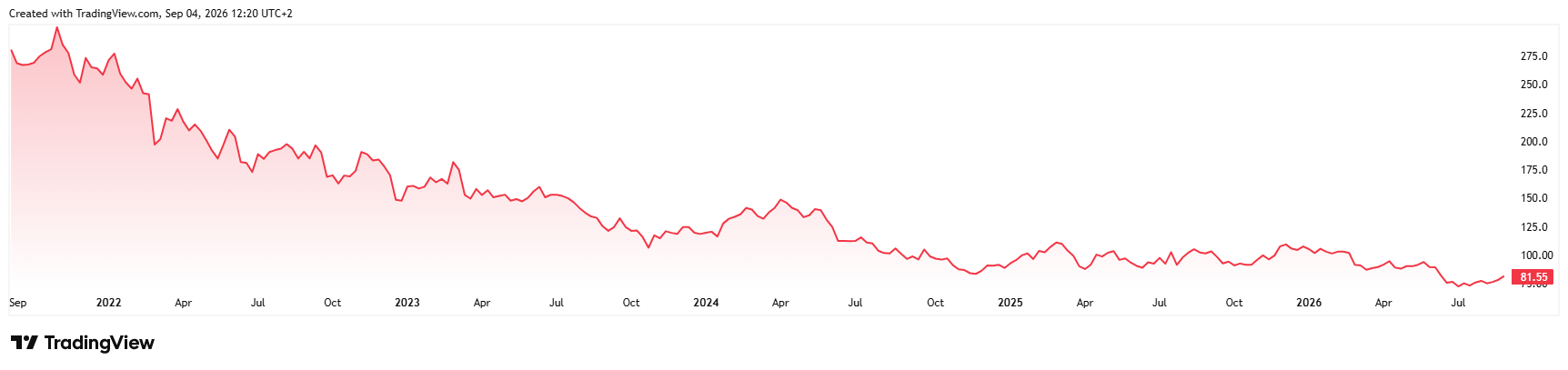
Volkswagen's Stock Price Performance Over the Past Five Years
The Overcapacity Trap and the Harsh Economics of Global Trade
The commercial landscape for European manufacturers has shifted fundamentally, with Volkswagen paying the price for a toxic combination of protectionism and Asian overproduction. In 2025 alone, the group recorded tariff expenses of €2.9B EUR (approximately $3.4B USD). Import tariffs on European-built cars soared from 2.5% to 15%, a sixfold increase, sharply inflating retail prices abroad. Compounding this pressure is aggressive competition from Chinese rivals led by BYD and Geely, which are rapidly capturing market share in the electric vehicle segment. As analysts at Carmignac observed, Europe is not merely importing Chinese vehicles, but rather "Chinese price deflation" fueled by massive domestic overcapacity. The entire crisis is best summarized by a stark contrast: while China suffers from an oversupply of cars, Europe suffers from an oversupply of factories originally built for a first generation of electric sedans that consumers no longer want.
Radical Lean Strategy
The antidote to this structural trap is a radical streamlining of product offerings. Volkswagen plans to shrink its model portfolio by roughly 50% by 2035, dramatically reducing manufacturing complexity and improving capital efficiency. As part of this deep reassessment, the future of four German plants remains uncommitted for the 2031–2034 production cycle, opening the door to repurposed manufacturing or further capacity rationalization. Yet cost reduction does not mean retreating from the market. CEO Oliver Blume emphasized that the group plans to invest a triple-digit billion sum, amounting to at least €100B+ EUR, over the coming years. These funds will strengthen individual brands, accelerate technological transformation, and fuel the development of products tailored to new market realities.
A Halo Effect for the Entire German Auto Sector
Analysts at Deutsche Bank delivered a clear verdict on the approved plan, calling it a "better-than-feared outcome." Prior to the announcement, many investors viewed Volkswagen's corporate structure as virtually unfixable. Unanimous approval of the restructuring by both management and labor unions demonstrates the company's ability to execute painful decisions in a city where deep cuts were historically blocked by entrenched political and union ties. This breakthrough creates a potential halo effect across the entire German automotive industry. Volkswagen has set a precedent, sending a clear message to peer European manufacturers struggling with sluggish growth and eroding margins: aggressively slashing redundant capacity is the only path left to preserve global competitiveness.
This marketing material is provided for informational purposes only and does not constitute investment advice, a recommendation, or an offer or solicitation to buy or sell any financial instruments.
Trading in securities involves significant risk and may not be suitable for all investors. Prices of securities may fluctuate significantly and may result in a total loss of your investment. Investors should be aware that losses may exceed potential profits when buying and selling securities. In certain market conditions, you may sustain losses that exceed your initial investment. Securities and contracts for differences are complex financial instruments that require a high level of knowledge and understanding. You should carefully consider whether you understand how these instruments work and whether you can afford to take the high risk of losing your money.


.png)