

Opening the Door to Foreign Capital
The long-awaited transition became a reality on Monday, September 21, when Vietnamese equities were officially included in FTSE Russell’s emerging market indices. The country thereby joined a category that also includes economic giants such as China and India. Vietnam had been on the watch list since 2018, and the index provider estimates that the move could attract up to USD 6 billion to the country. Asset manager Vanguard has also demonstrated significant interest, planning to increase its investments in Vietnam to approximately USD 2.5 billion over the coming years.
Initial Gains Tempered by Caution
The prospect of capital inflows was immediately reflected in trading. Vietnam’s benchmark index opened Monday’s session up 0.54%, driven primarily by the banking sector, before edging lower. The anticipated reclassification had already revived foreign interest ahead of its implementation. According to data from the Ho Chi Minh Stock Exchange, net purchases by foreign investors reached VND 2.7 trillion (approximately USD 104 million) last week. Despite this short-term recovery, their overall long-term balance still shows net sales of approximately VND 91 trillion. Thomas Nguyen, director of global markets at SSI Securities Corporation, the country’s second-largest broker by market share, therefore expects the initial enthusiasm to fade and trading to remain relatively subdued until 2027.
Five-Year Performance Remains Positive
Despite these cautious expectations for the coming months, the Vietnam VSE index has gained approximately 32% over the past five years. Its inclusion in FTSE Russell’s indices thus follows a longer period of overall appreciation in the Vietnamese stock market. Attention now shifts to how the gradual arrival of anticipated foreign capital will influence its future performance.
Vietnam VSE Index Performance Over the Past Five Years [VND]
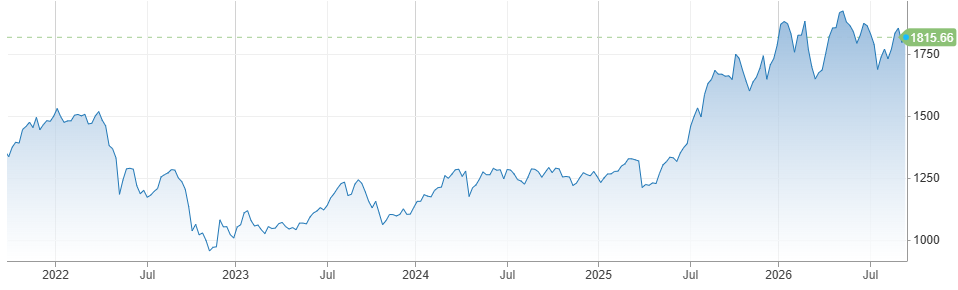
(Source: CNBC)
Inclusion in Four Phases
These capital inflows will not arrive all at once, as the transition will be spread across four stages: 10% of the allocation is scheduled for September 2026, a further 20% for March 2027, and 35% each for June and September next year. Nguyen expects investor interest to pick up again as the March tranche approaches, with the larger allocation having a more noticeable impact on the local market. However, concerns persist over foreign ownership limits and the limited free float of some companies.
MSCI Is the Next Target
Successful inclusion in FTSE Russell’s indices has also revived expectations that MSCI could upgrade Vietnam in the future. An important step towards that goal will be the introduction of central counterparty clearing, expected in 2027, which investors believe could bring the country closer to meeting MSCI’s market access requirements. Nguyen considers this mechanism crucial, emphasising that while FTSE focuses primarily on market accessibility, overall market scale also plays an important role for MSCI.
This marketing material is provided for informational purposes only and does not constitute investment advice, a recommendation, or an offer or solicitation to buy or sell any financial instruments.
Trading in securities involves significant risk and may not be suitable for all investors. Prices of securities may fluctuate significantly and may result in a total loss of your investment. Investors should be aware that losses may exceed potential profits when buying and selling securities. In certain market conditions, you may sustain losses that exceed your initial investment. Securities and contracts for differences are complex financial instruments that require a high level of knowledge and understanding. You should carefully consider whether you understand how these instruments work and whether you can afford to take the high risk of losing your money.
Source:
https://www.cnbc.com/quotes/.VNI

.png)