
.jpg)
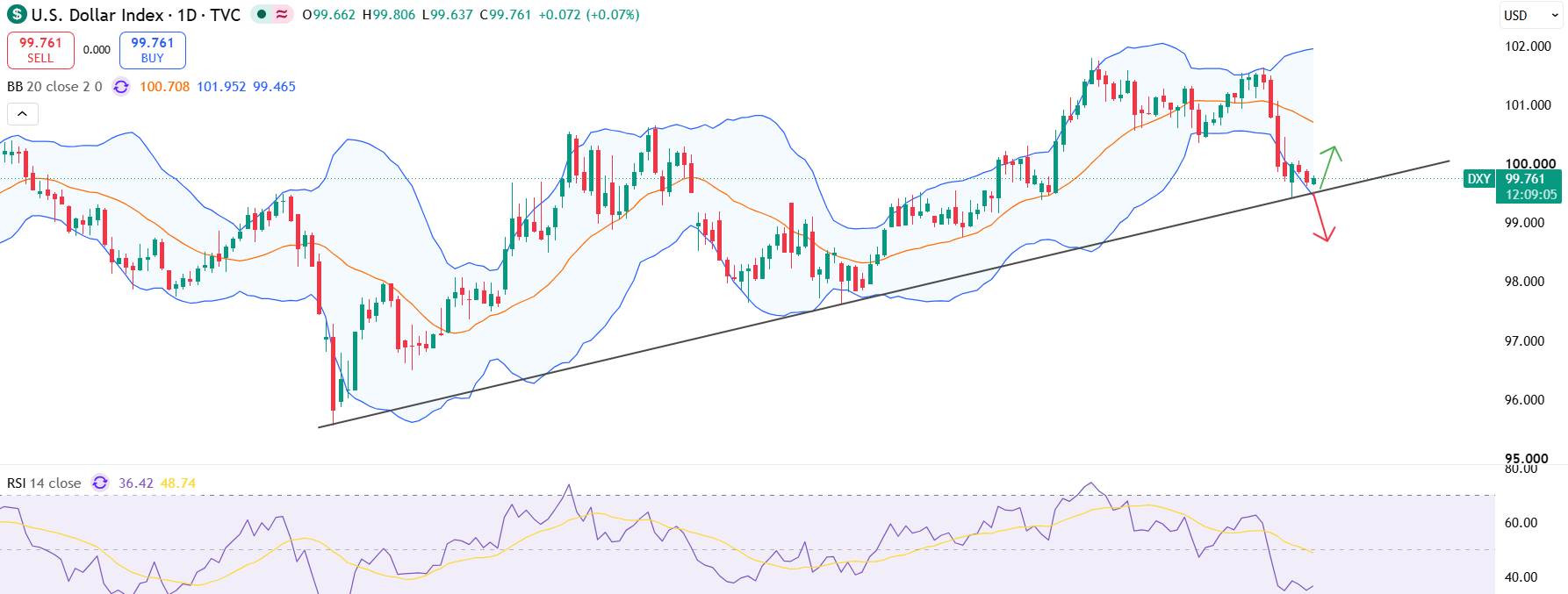
After falling to a fresh seven-week low, the index showed a modest recovery from trendline support near 99.40. However, this rebound quickly lost momentum as market participants adopted a cautiously optimistic stance regarding the potential for a diplomatic agreement between the United States and Iran.
Improving Risk Sentiment Weighs on the Dollar
Global risk appetite has strengthened considerably following reports of increasing diplomatic optimism between Washington and Tehran. The diminished risk of a broader Middle East conflict has reduced demand for defensive assets, including the U.S. dollar.
Concurrently, lower energy prices have alleviated near-term inflation concerns, which in turn have moderated expectations for a more aggressive monetary tightening by the Federal Reserve.
Fundamental Outlook Remains Mixed
The overall fundamental outlook remains uncertain. A scenario featuring continued U.S. dollar weakness alongside stronger performance in risk assets through late August appears to be a reasonable base-case scenario. Nonetheless, this outlook could shift if geopolitical tensions escalate or if U.S. economic data significantly strengthens, potentially supporting a more hawkish interest rate stance. Traders should remain vigilant to diplomatic developments and upcoming economic data releases for clearer directional insights.
For the remainder of the week, attention will turn to Friday’s key U.S. labour-market report. Market participants will also closely follow Federal Reserve commentary for further guidance on the interest-rate outlook. Notably, Federal Reserve Board Governor Lisa Cook recently expressed willingness to support an interest rate increase if inflation does not sufficiently decline toward the central bank’s target.
The 99.40–99.20 Area Remains Critical Support
From a technical perspective, the DXY currently maintains a neutral-to-slightly bullish short-term bias following its rebound from the important 99.40 support area. However, the 14-period Relative Strength Index remains within the bearish 20.00–40.00 range, indicating that downside momentum is still established despite the recent recovery.
The index slipped below the psychological 100.00 level before stabilizing near 99.40 and initiating a modest corrective rally. Key support for the dollar is currently located in the 99.40/20 range. Holding above this zone could enable a relief rally targeting 99.80 initially and, if momentum strengthens, the 100.20–100.30 region. Conversely, a sustained break below 99.40, particularly beneath 99.20, may trigger a deeper and more prolonged decline.
Conclusion
In summary, the U.S. dollar remains at a critical juncture both technically and fundamentally. The near-term trajectory will likely hinge on whether improving risk sentiment continues to dampen safe-haven demand or if stronger U.S. economic data revives expectations for tighter Federal Reserve monetary policy.
This marketing material is provided for informational purposes only and does not constitute investment advice, a recommendation, or an offer or solicitation to buy or sell any financial instruments.
Trading in securities involves significant risk and may not be suitable for all investors. Prices of securities may fluctuate significantly and may result in a total loss of your investment. Investors should be aware that losses may exceed potential profits when buying and selling securities. In certain market conditions, you may sustain losses that exceed your initial investment. Securities and contracts for differences are complex financial instruments that require a high level of knowledge and understanding. You should carefully consider whether you understand how these instruments work and whether you can afford to take the high risk of losing your money.


.png)