
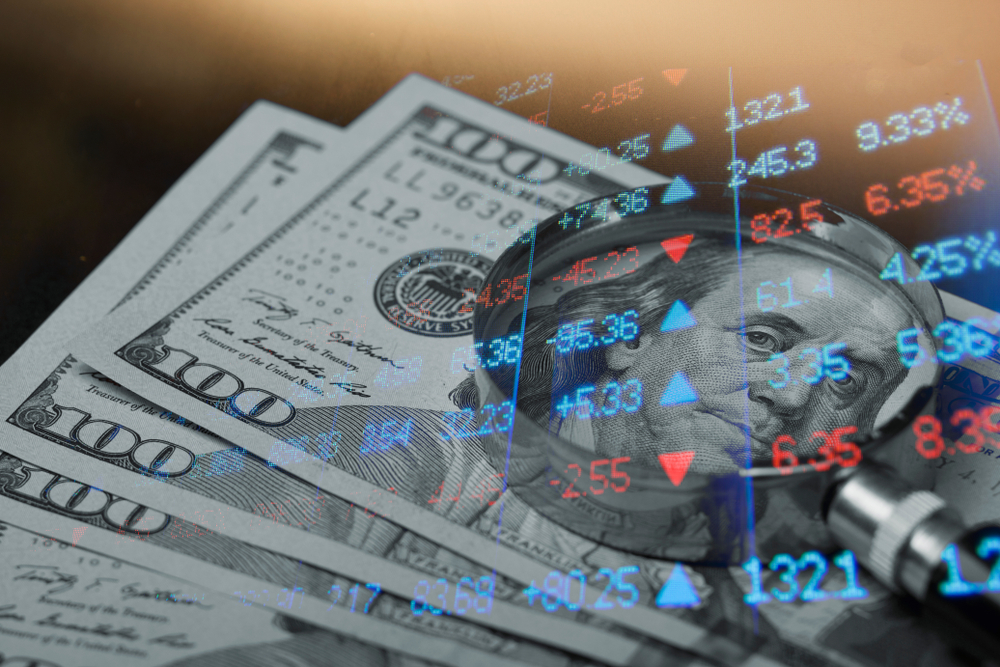
The DXY measures the value of the US dollar against a basket of six foreign currencies, in which the euro has the largest weighting, at 57.6%. Therefore, the movement of the index often reflects the economic difference between the US and Europe. The remaining five currencies (JPY, GBP, CAD, SEK, CHF) represent less than half of the total weight. The point of operation is simple. A rise in the DXY means a stronger dollar, while a decline means a weaker dollar. And this simple relationship can have a major impact on global financial markets.
Why is DXY so important?
The DXY is especially important because most global commodities are traded in dollars. When the dollar strengthens, they become more expensive for foreign investors, which often leads to a drop in crude oil or gold prices. The same effect is also seen in stocks and cryptocurrencies. Periods of a strong dollar are usually accompanied by a lower willingness to take risks. Conversely, a weakening dollar supports the growth of risky assets. The DXY is therefore a very useful indicator of overall sentiment. When the situation is uncertain, the dollar rises as people divest themselves of risk-on assets. On the other hand, when the mood is calmer, investors move back into higher-risk markets. [2]
What affects the DXY
The value of the DXY is mainly influenced by decisions made by the US Federal Reserve (Fed), which sets interest rates and determines how much new money is put into circulation. Macroeconomic data such as inflation and unemployment also have a strong impact. Of course, it should be considered that decisions made by other central banks also have an impact on the index itself. In the case of the eurozone, it is essential to monitor the decisions of the European Central Bank (ECB).
Conclusion
The DXY is an inconspicuous but extremely important market indicator. It shows us investor sentiment, the direction of capital, and the overall sentiment on global markets. It is a compass that points the way before the markets realize it. That is why it is worth watching even if you are only a marginal investor.
[1,2] Forward-looking statements are based on assumptions and current expectations, which may be inaccurate, or based on the current economic environment which is subject to change. Such statements are not guaranteeing of future performance. They involve risks and other uncertainties which are difficult to predict. Results could differ materially from those expressed or implied in any forward-looking statements.

.png)