
.jpg)
back in as momentum began to build, with the dollar respecting the rising trendline support.
USD surrenders a major part of its gains from last week
The past few trading sessions have been challenging for the “king dollar.” The US dollar retreated further during the second half of Thursday’s session, giving back much of the gains it had made last week. Momentum waned after major central banks—including the European Central Bank (ECB), Bank of England (BoE), and Bank of Japan (BoJ)—signaled a hawkish bias, citing rising energy prices and Middle East tensions as key inflation risks.
Looking ahead, the dollar is likely to remain supported amid prevailing risk-off sentiment in global markets, as it is traditionally viewed as a safe-haven investment during periods of geopolitical uncertainty.
Dollar Index (DXY) technical forecast: Watch the trendline support
Technically, momentum has been neutral to bearish throughout the week. However, the Relative Strength Index (RSI) remains above 55, indicating balanced momentum and room for a potential upward move if buyers regain control. The recent healthy correction also helped the index exit overbought territory, suggesting that as long as the rising trendline holds, the market remains positioned for another advance.
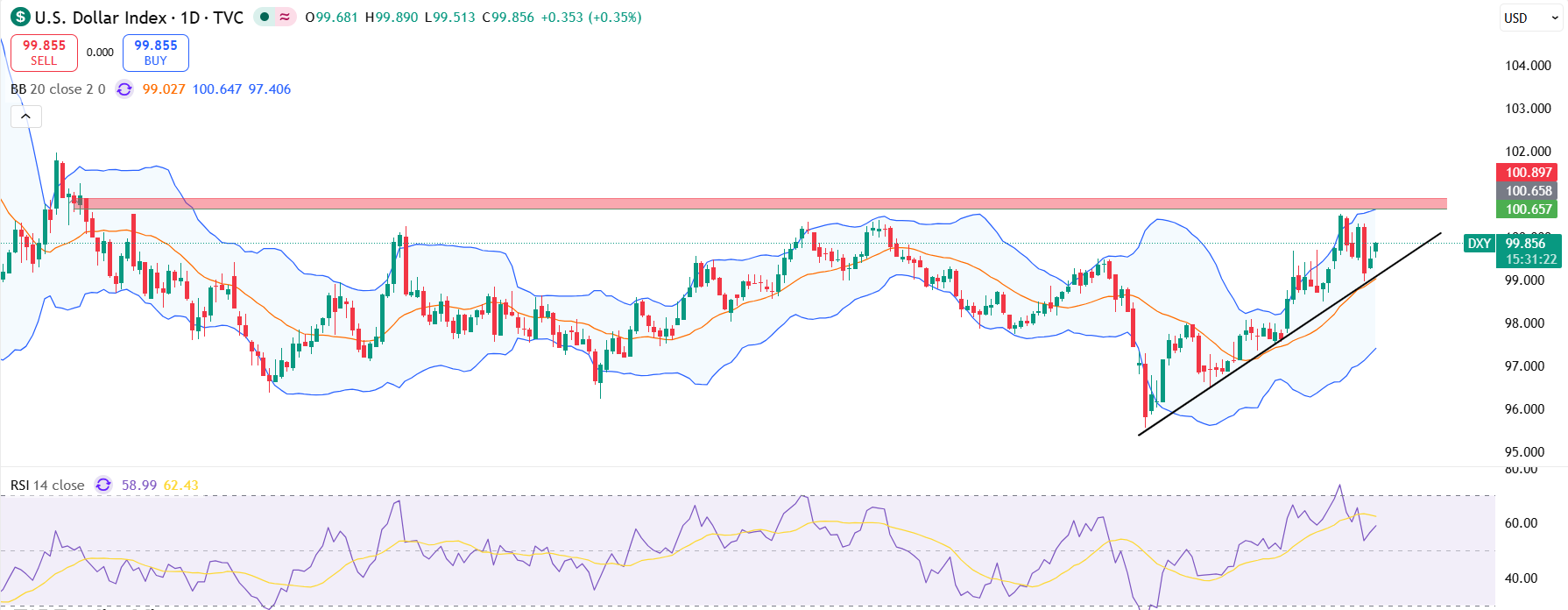
If bulls continue to defend this support area, the index could push toward the upper liquidity zone near previous highs. The first resistance level is likely around 100, while sustained buying pressure could drive the index higher toward a second resistance zone at 100.40–100.50. However, if selling is your thing, then you might wait for the USD to approach the monthly peak before deciding to go short.
* Past performance is no guarantee of future results
[1] Forward-looking statements are based on assumptions and current expectations, which may be inaccurate, or based on the current economic environment which is subject to change. Such statements are not guaranteeing of future performance. They involve risks and other uncertainties which are difficult to predict. Results could differ materially from those expressed or implied in any forward-looking statements.


.png)