

During the Asian session on Wednesday, EUR/USD gained strong bullish momentum following news of a US-Iran ceasefire, signaling potential high volatility for the remainder of the week. The United States and Iran agreed to a two-week ceasefire, which includes reopening the Strait of Hormuz and initiating talks.
Looking ahead, euro movement is expected to remain highly volatile over the next few days as markets stay sensitive to any developments involving Trump or Iran.
What to Focus on Next?
In the second half of the week, euro traders should monitor Thursday’s German Industrial production and Friday’s consumer inflation data from Germany. The Consumer Price Index (CPI) will be particularly important, as it influences the European Central Bank’s rate decisions. Meanwhile, the US dollar’s movement will continue to play a crucial role in determining the EUR/USD direction. Key upcoming US data points include the FOMC meeting minutes, US CPI, core PCE, and jobless claims report.
EURUSD Technical Outlook
From a technical perspective, the hourly chart shows the euro continuing its rebound. However, if the pair fails to settle above the critical 1.1700 level, traders should consider booking profits on long positions. The 1.1700 level is a significant psychological and technical barrier, having acted as both strong support and resistance throughout 2025 and into 2026.
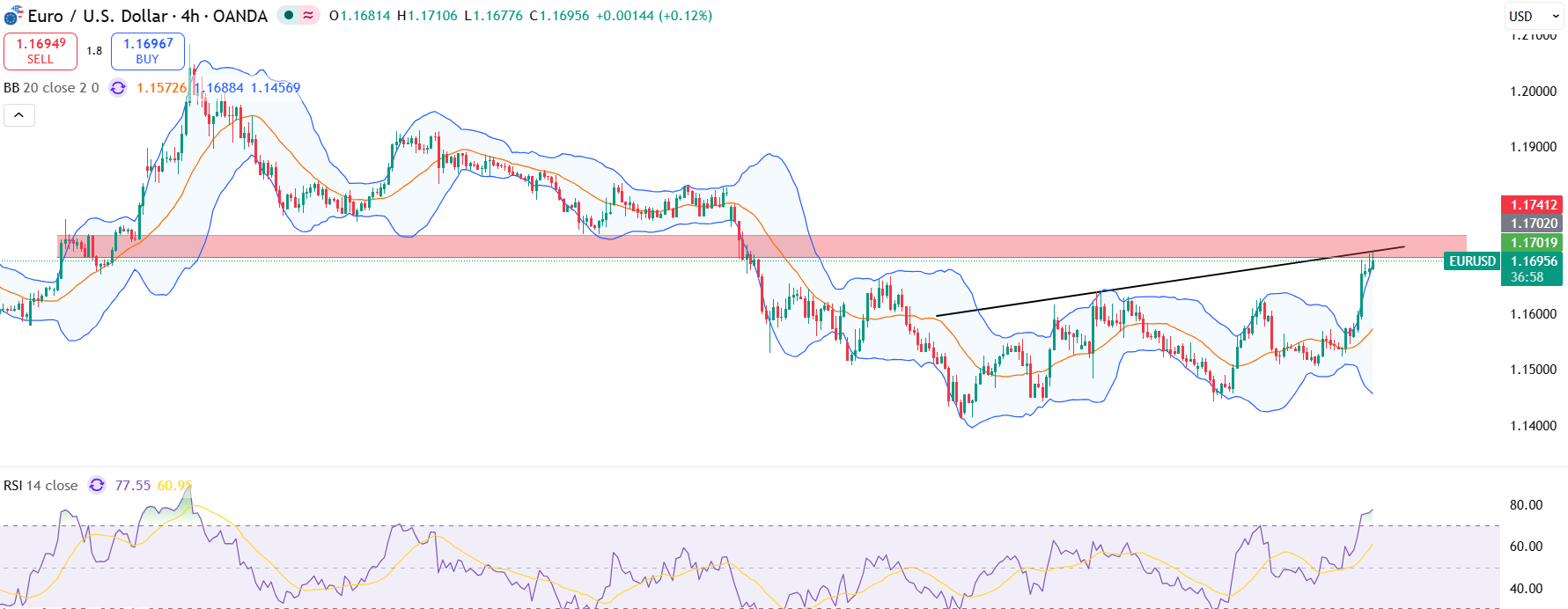
Technically, on the upside, if bullish momentum strengthens, the pair is likely to test the static resistance at 1.1730 first, followed by the 1.1760 to 1.1770 range. On the downside, a break below 1.1600 would signal a resumption of the downtrend.
This marketing material is provided for informational purposes only and does not constitute investment advice, a recommendation, or an offer or solicitation to buy or sell any financial instruments.
Trading in securities involves significant risk and may not be suitable for all investors. Prices of securities may fluctuate significantly and may result in a total loss of your investment. Investors should be aware that losses may exceed potential profits when buying and selling securities. In certain market conditions, you may sustain losses that exceed your initial investment. Securities and contracts for differences are complex financial instruments that require a high level of knowledge and understanding. You should carefully consider whether you understand how these instruments work and whether you can afford to take the high risk of losing your money.

.png)